A teacher holds up an "sh" digraph card to a small group of elementary students with wooden letter tiles spelling "ship" and "shop" on the reading table — explicit phonics instruction in action.

What Is Phonics Instruction? A Guide for Teachers

Phonics instruction teaches the relationships between letters and sounds so students can decode words. Learn systematic phonics, scope and sequence, and how to teach it.


Find out more about
Science of Reading
Will Jackson, CEO
June 9, 2026
, last updated on
June 9, 2026
,
5
min read

Phonics instruction teaches students the relationships between letters and the sounds they represent so they can decode written words. It is one of the five pillars of reading identified by the National Reading Panel, and it is most effective when it is explicit and systematic. This guide explains what phonics instruction is, how systematic phonics differs from incidental phonics, and how to teach it.

What Is Phonics Instruction?

Phonics instruction teaches the predictable relationships between sounds and the letters that represent them. Once students learn that letters map to sounds, they can blend those sounds to read words they have never seen before. Phonics is the link that turns spoken language into printed words and back again.

Phonics sits within the word-recognition strands of skilled reading described on our science of reading overview, alongside phonemic awareness.

Systematic vs Incidental Phonics

Systematic phonics teaches letter-sound relationships explicitly and in a planned order, while incidental phonics addresses them only as they happen to come up. The National Reading Panel found systematic phonics more effective than incidental approaches, particularly for early readers and students who struggle.

Explicit means the teacher directly teaches each relationship rather than expecting students to infer it. Systematic means the relationships are taught in a deliberate sequence that builds over time.

A Typical Phonics Scope and Sequence

Systematic phonics follows a scope and sequence that moves from simpler to more complex patterns. A common progression looks like this:

  • Letter sounds: the sounds of individual letters.
  • CVC words: simple consonant-vowel-consonant words like cat and bed.
  • Digraphs: two letters making one sound, such as sh and ch.
  • Consonant blends: clusters like st and bl.
  • Vowel teams: pairs like ea and oa.

The exact order varies by program, but the principle is the same: build deliberately from the simplest patterns to the most complex.

How Mote Supports Phonics Practice

Mote is not a phonics program, and it does not replace the explicit instruction a teacher provides. What Mote adds is access and practice: Read Aloud lets students hear words modeled accurately, and the dictionary supports word meaning once a word is decoded. Used alongside systematic phonics, Mote helps developing readers engage with grade-level text while their decoding skills grow.

The Bottom Line

Phonics instruction teaches students to connect sounds and letters so they can decode any word. Teach it explicitly and systematically, follow a deliberate scope and sequence, and pair it with phonemic awareness. Tools like Mote can support access and practice, but the explicit phonics instruction you provide is what unlocks decoding.

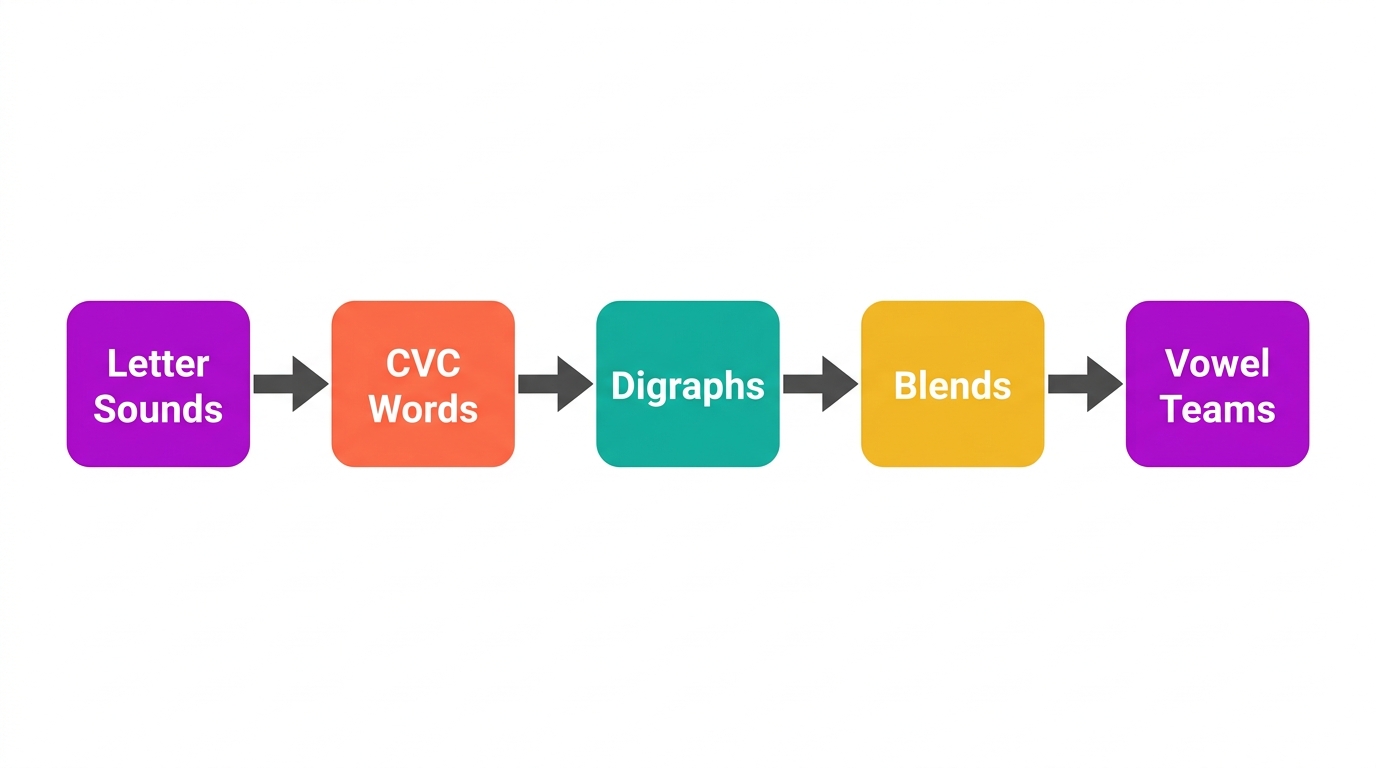
Diagram showing sounds leading to letters leading to words in phonics instruction.
Phonics connects sounds to letters so students can read words.

How to Teach Phonics Systematically

Requires:
Mote Chrome Extension, an explicit phonics scope and sequence, decodable texts

1. Follow an Explicit Scope and Sequence

Teach letter-sound relationships in a deliberate order, from single sounds to vowel teams, rather than as they happen to appear.

2. Teach Each Relationship Directly

Introduce a sound-letter pattern, model it, and have students practice it, instead of expecting them to infer it.

3. Practice Blending and Decoding

Have students blend the sounds to read words and use decodable text that matches the patterns taught.

4. Connect to Phonemic Awareness

Pair phonics with oral sound work so students link the sounds they hear to the letters they see.

5. Review and Monitor Progress

Revisit earlier patterns regularly and track decoding accuracy to catch gaps early.

Diagram of a phonics scope and sequence: letter sounds, CVC words, digraphs, blends, vowel teams.
A typical systematic phonics scope and sequence from letter sounds to vowel teams.

Frequently Asked Questions

Common questions about
Science of Reading

Qu'est-ce que l'enseignement de la phonétique ?

L'enseignement de la phonétique enseigne les relations entre les lettres et les sons qu'elles représentent, ce qui permet aux élèves de décoder les mots écrits. C'est l'un des cinq piliers de la lecture et il fonctionne mieux quand il est explicite et systématique.

Quelle est la différence entre la phonique systématique et la phonique incidente ?

La phonique systématique enseigne les relations entre les lettres et les sons de manière explicite et dans une séquence planifiée, tandis que la phonique incidente les aborde uniquement au fur et à mesure qu'elles se présentent à la lecture. La recherche du National Reading Panel a révélé que la phonique systématique est plus efficace, en particulier pour les lecteurs en début d'apprentissage et les lecteurs en difficulté.

Dans quel ordre enseigner la phonétique ?

Une séquence phonétique type débute par les sons isolés des lettres, puis progresse vers les mots CVC simples, les digrammes, les groupes de consonnes et les équipes de voyelles, en construisant de motifs plus simples vers plus complexes. La séquence exacte varie selon le programme, mais elle doit être délibérée plutôt qu'aléatoire.

Quelle est la différence entre la phonétique et la conscience phonémique ?

La conscience phonémique est une compétence orale : il s'agit d'entendre et de manipuler les sons dans les mots parlés, sans aucune lettre impliquée. La phonétique relie ces sons aux lettres écrites. La conscience phonémique soutient la phonétique, et les deux sont souvent enseignées ensemble.

L'enseignement de la phonétique aide-t-il les élèves atteints de dyslexie ?

Oui. La phonétique explicite et systématique est particulièrement importante pour les élèves atteints de dyslexie, qui éprouvent souvent du mal à déduire les correspondances lettre-son par eux-mêmes. L'Association internationale de la dyslexie recommande la littératie structurée, qui met la phonétique systématique au cœur.

Essayez Mote gratuitement

Aucune carte requise

© Mote Technologies, Inc. 2026. Conçu avec 💜 par notre équipe mondiale.